On September 1, 1923, the Great Kanto Earthquake struck Japan shortly before noon, devastating Tokyo, Yokohama, and communities across the southern Kanto region. Commonly estimated at about magnitude 7.9, the earthquake triggered building collapses, enormous urban fires, landslides, and tsunami waves that turned a powerful seismic event into a far-reaching humanitarian catastrophe.
More than 100,000 people were killed or reported missing, although historical estimates vary. Hundreds of thousands more were displaced.
Yet the significance of the 1923 Great Kanto Earthquake extends beyond the destruction itself. The disaster transformed Tokyo’s urban landscape, influenced Japanese earthquake engineering and disaster preparedness, and was followed by a disturbing wave of rumors and violence against Korean residents and others.
Understanding what happened in 1923 therefore means examining not only the earthquake, but also the social, political, and urban consequences that followed it.
Key Takeaways About the Great Kanto Earthquake
- The Great Kanto Earthquake struck on September 1, 1923, at approximately 11:58 a.m. local time.
- The earthquake is generally estimated at approximately magnitude 7.9, although historical magnitude calculations vary somewhat.
- Tokyo and Yokohama were among the cities most severely affected.
- Massive fires following the earthquake caused an extraordinary share of the destruction and loss of life.
- The disaster also triggered tsunami waves and landslides in parts of the wider region.
- More than 100,000 people were killed or went missing, with some historical estimates considerably higher.
- Hundreds of thousands of homes were destroyed or damaged, leaving large numbers of people displaced.
- False rumors after the disaster helped fuel mass violence against Korean residents, along with attacks on Chinese residents and some Japanese people.
- The reconstruction of Tokyo introduced important changes to roads, parks, bridges, infrastructure, and urban planning.
- September 1 eventually became closely associated with disaster preparedness in Japan and is observed as Disaster Prevention Day.
What Was the Great Kanto Earthquake?
The Great Kanto Earthquake, also written as the Great Kantō Earthquake, was a major earthquake that struck Japan’s Kanto region in 1923.
The Kanto region is located on the island of Honshu and includes Tokyo, Yokohama, and several surrounding prefectures. Because this area was already heavily populated and economically important by the early 20th century, the earthquake struck at the heart of modern Japan.
The disaster was far more complicated than a single period of violent ground shaking.
Buildings collapsed across the region. Fires spread through densely built urban neighborhoods. Coastal communities experienced tsunami damage. Mountainous areas suffered landslides and slope failures. Roads, railways, water systems, communications, and other infrastructure were disrupted.
Together, these hazards created one of the most destructive disasters in modern Japanese history.
The catastrophe also demonstrates an important principle of disaster preparedness: the danger from an earthquake does not end when the ground stops shaking. Secondary hazards can become equally destructive—or even more destructive—than the initial seismic event.
When and Where Did the Great Kanto Earthquake Happen?
The Great Kanto Earthquake occurred on September 1, 1923, at approximately 11:58 a.m. local time.
Its source was associated with the area around Sagami Bay, south of Tokyo.
Severe damage occurred throughout southern Kanto, including:
Tokyo, Yokohama, Kanagawa Prefecture, Chiba Prefecture, parts of Shizuoka Prefecture, and numerous coastal and inland communities.
The timing contributed significantly to the disaster.
It was almost noon, meaning many families, restaurants, and businesses were preparing lunch. Open flames, cooking stoves, and other heat sources were in use throughout densely populated neighborhoods.
When the earthquake overturned stoves and damaged buildings and infrastructure, fires broke out in numerous locations almost simultaneously.
Where Was the Epicenter of the Great Kanto Earthquake?
The earthquake originated in the Sagami Bay region, near the Sagami Trough south of Tokyo.
The Sagami Trough is an active tectonic boundary where the movement of Earth’s crust creates substantial earthquake potential.
Because the earthquake originated relatively close to heavily populated parts of the Kanto region, Tokyo and especially Yokohama experienced severe shaking and widespread destruction.
What Caused the Great Kanto Earthquake?
The Great Kanto Earthquake was caused by the movement of tectonic plates beneath Japan.
Earth’s outer shell is divided into enormous pieces known as tectonic plates. These plates are constantly moving, although usually only by small amounts each year.
Japan sits in one of the world’s most tectonically active regions, where several major plates and smaller crustal blocks interact.
Near the Sagami Trough, one plate is forced beneath another in a process called subduction.
Plate boundaries do not always move smoothly. Sections can become locked because of friction while the surrounding plates continue moving. Stress gradually accumulates.
Imagine bending a rigid object until it suddenly slips or snaps back into a new position. At a tectonic boundary, an enormous amount of accumulated stress can be released when the locked section suddenly moves.
That sudden movement sends seismic waves through the surrounding crust.
In 1923, rapid fault movement along the plate-boundary system near Sagami Bay released tremendous seismic energy, producing the Great Kanto Earthquake.
The Sagami Trough and the Great Kanto Earthquake
The Sagami Trough is an important part of understanding earthquake risk around the greater Tokyo region.
It forms part of a complex tectonic environment where the Philippine Sea Plate interacts with the crust beneath central Japan.
Because movement along a subduction boundary can become locked for long periods, significant amounts of strain can accumulate before being released during an earthquake.
Japan’s tectonic setting is complicated, however, so simplified diagrams showing only two plates cannot capture every geological process occurring beneath the Kanto region.
Was the Great Kanto Earthquake a Megathrust Earthquake?
The 1923 earthquake is commonly associated with major subduction-zone faulting along the Sagami Trough.
A megathrust earthquake occurs when a large section of the boundary between converging tectonic plates suddenly slips.
These earthquakes can become extremely powerful because the fault area involved may be very large. When significant movement occurs beneath or near the ocean, it can also displace seawater and generate a tsunami.
How Strong Was the Great Kanto Earthquake?
The Great Kanto Earthquake is commonly described as having a magnitude of approximately 7.9, although estimates for historical earthquakes can differ depending on the measurement method and data used.
Modern earthquakes can be measured using sophisticated global networks of seismic instruments. Scientists studying an earthquake from 1923 have a more limited historical record, which helps explain why different catalogs sometimes report slightly different magnitudes.
It is also important to distinguish magnitude from intensity.
Magnitude measures the overall size and energy of an earthquake.
Intensity describes how strongly the earthquake is experienced at a particular location and the effects it produces there.
Two cities affected by the same earthquake can therefore experience very different levels of destruction depending on their distance from the fault, local geology, building construction, and other conditions.
How Long Did the Great Kanto Earthquake Last?
The most violent ground motion lasted only a matter of minutes, but the disaster continued much longer.
Buildings had already collapsed. Fires were spreading. Transportation and communications were damaged. Survivors were searching for relatives and attempting to reach safer areas.
Aftershocks added further fear and danger.
In practical terms, the consequences of the earthquake unfolded over hours, days, months, and ultimately years.
Why Was the Great Kanto Earthquake So Destructive?
The Great Kanto Earthquake became exceptionally destructive because several hazards occurred together.
Powerful shaking damaged buildings and infrastructure, but the resulting fires became especially catastrophic in Tokyo and Yokohama.
Tsunamis damaged coastal communities, while landslides affected other parts of the region.
The concentration of people and buildings in major urban areas magnified the consequences.
Fires After the Great Kanto Earthquake
Fire was one of the defining features of the disaster.
The earthquake struck near lunchtime, when cooking fires and stoves were widely being used. The shaking overturned heat sources and damaged buildings, causing fires to break out across urban neighborhoods.
Conditions made controlling them exceptionally difficult.
Many buildings were constructed largely from wood and other combustible materials. Neighborhoods were densely packed, allowing flames to move rapidly from one structure to another.
Damaged water mains reduced access to water for firefighting.
Roads were obstructed by rubble and fleeing residents. Firefighters had difficulty reaching many burning areas.
Wind further complicated the situation.
In some places, intense heat and turbulent air contributed to extremely dangerous fire behavior, including phenomena historically described as fire whirls.
For thousands of residents who had survived the earthquake itself, escaping the rapidly spreading fires became the next struggle for survival.
The Great Kanto Earthquake Tsunami
The Great Kanto Earthquake also generated a tsunami.
When a major earthquake causes sudden vertical movement of the seafloor, the water above it can be displaced. That disturbance travels outward as a series of waves.
Coastal communities around Sagami Bay and neighboring areas experienced tsunami damage after the 1923 earthquake.
The tsunami did not account for most of the overall destruction in Tokyo, but it added another deadly hazard for communities along the coast.
Landslides Triggered by the Great Kanto Earthquake
Powerful shaking also destabilized hillsides and steep slopes.
Landslides and other ground failures damaged communities, blocked transportation routes, and caused additional deaths outside the most heavily documented urban centers.
These secondary hazards demonstrate why referring to the event simply as the 1923 Tokyo earthquake can be misleading. The disaster affected a much wider area than Tokyo alone.
How Tokyo and Yokohama Were Destroyed by the Great Kanto Earthquake
Both Tokyo and Yokohama suffered catastrophic damage, although the pattern of destruction differed between the two cities.
In Tokyo, buildings collapsed and fires spread through densely populated districts. Roads and transportation systems were disrupted, public services failed, and enormous numbers of people fled damaged neighborhoods.
Open spaces became improvised refuges for survivors.
Yokohama, located closer to the earthquake’s source, experienced extraordinarily severe structural damage.
Homes, businesses, government buildings, and infrastructure were destroyed or heavily damaged. Fires added to the destruction, while damage to Yokohama’s important port disrupted trade and commercial activity.
The catastrophe also affected the city’s international community, reflecting Yokohama’s prominent role as a commercial port connected with the wider world.
In both cities, the disaster transformed recognizable urban landscapes into scenes of rubble, smoke, displacement, and emergency shelter.
Great Kanto Earthquake Death Toll and Human Cost
The exact Great Kanto Earthquake death toll remains difficult to express as one universally accepted number.
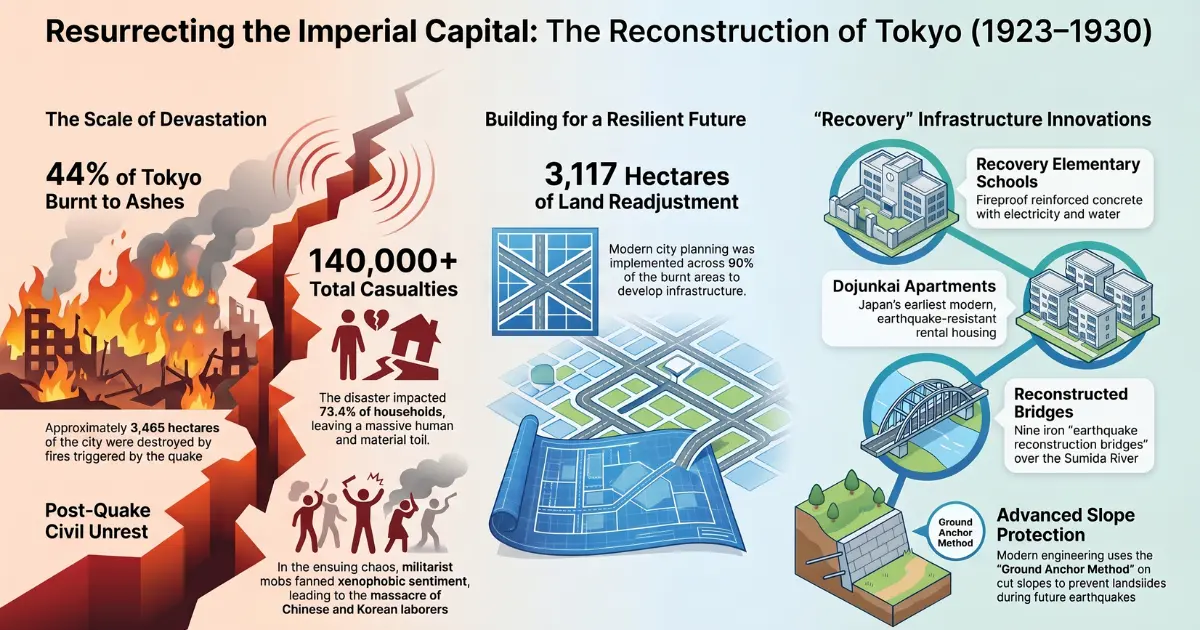
Modern historical assessments generally indicate that more than 100,000 people were killed or reported missing. Other frequently cited historical estimates rise toward or above 140,000.
Regardless of which calculation is used, the human cost was enormous.
Thousands were injured.
Families were separated during chaotic evacuations.
Entire neighborhoods disappeared.
Large numbers of residents lost their homes and possessions, creating an immediate refugee and humanitarian crisis.
Fire accounted for a particularly large share of the deaths, underscoring how secondary disasters can dramatically increase the human consequences of an earthquake.
Why Do Great Kanto Earthquake Death Estimates Differ?
Several factors explain why historical sources report different totals.
The disaster destroyed homes, government buildings, records, and communications. Some victims were listed as missing without their eventual fate being confirmed. Intense fires made identification difficult.
Different historical authorities also counted casualties using different definitions and methods.
For these reasons, it is more accurate to acknowledge the uncertainty than to present one number as completely definitive.
The Great Kanto Earthquake and the Massacre of Koreans
One of the darkest chapters of the Great Kanto Earthquake occurred after the natural disaster had struck.
In the confusion that followed the earthquake, false rumors began circulating about Korean residents. Koreans were falsely accused of poisoning wells, committing arson, and preparing attacks.
Fear, prejudice, and misinformation spread rapidly.
Vigilante groups attacked and killed Korean residents across parts of the affected region.
Chinese residents were also victims of violence. Some Japanese people were attacked after being mistaken for Koreans.
The exact number of people killed remains disputed, but the occurrence of widespread anti-Korean violence is well documented.
The episode is an important part of the history of the Great Kanto Earthquake because it demonstrates how misinformation can become dangerous during a crisis.
A natural disaster had already damaged communications and weakened normal social order. Rumors filled the resulting information vacuum, while existing xenophobia made those rumors easier for some people to believe.
The Kantō Massacre therefore remains not only a subject of historical remembrance but also a warning about the potentially deadly consequences of disaster misinformation, scapegoating, and social panic.
Relief Efforts After the Great Kanto Earthquake
The scale of destruction created an enormous emergency response challenge.
Survivors needed food, clean water, medical treatment, shelter, and information. Temporary camps and emergency shelters were established as displaced residents searched for relatives and attempted to rebuild their lives.
Government agencies, military personnel, local authorities, medical workers, volunteers, and relief organizations participated in response efforts.
International assistance also contributed to relief.
Delivering help was difficult because roads, railways, ports, communications, and other infrastructure had been damaged.
The Great Kanto Earthquake exposed how difficult it could be to coordinate emergency relief across a vast urban disaster zone.
Rebuilding Tokyo After the Great Kanto Earthquake
The destruction of Tokyo presented Japan with a challenge: rebuild the city as it had existed before, or use the catastrophe as an opportunity to create a more modern capital.
Reconstruction ultimately introduced major changes to Tokyo’s urban environment.
Gotō Shinpei, an influential statesman and former mayor of Tokyo, became one of the most important figures associated with plans for rebuilding the capital.
Reconstruction projects included wider roads, bridges, parks, improved infrastructure, land readjustment, and other elements of modern city planning.
Wider streets and strategically placed open spaces also had potential disaster-resilience benefits because they could improve evacuation and help limit the spread of urban fires.
Not every reconstruction proposal was fully implemented, and financial and political constraints reduced the scale of some plans.
Even so, the rebuilding effort left a lasting imprint.
Much of modern Tokyo’s urban development cannot be understood without considering the transformation that followed the Great Kanto Earthquake.
How the Great Kanto Earthquake Changed Japan
The Great Kanto Earthquake influenced Japan far beyond the immediate reconstruction of Tokyo and Yokohama.
The catastrophe demonstrated the vulnerability of densely populated cities to earthquakes and secondary fires.
It encouraged greater attention to:
Earthquake-resistant architecture, building standards, urban fire prevention, seismic research, emergency planning, infrastructure resilience, and public disaster awareness.
The disaster also became deeply embedded in Japan’s culture of preparedness.
September 1 is now observed as Disaster Prevention Day, when government agencies, communities, schools, workplaces, and other organizations emphasize disaster awareness and preparedness.
The connection between the date and disaster preparedness keeps the lessons of 1923 visible more than a century later.
Why the Great Kanto Earthquake Still Matters Today
The Great Kanto Earthquake remains relevant because the Tokyo metropolitan region continues to face significant seismic risk.
Modern Japan has technologies and protections that did not exist in 1923, including earthquake-resistant construction, sophisticated seismic monitoring, early-warning systems, emergency communications, tsunami planning, and extensive disaster exercises.
Technology, however, cannot eliminate earthquake risk.
The events of 1923 demonstrate the importance of designing resilient cities, preparing for secondary hazards such as fire and tsunami, maintaining reliable emergency information, and preventing rumors from escalating during a crisis.
Perhaps the most enduring lesson of the Great Kanto Earthquake is that disaster preparedness must address both physical hazards and human behavior.
Great Kanto Earthquake FAQs
When did the Great Kanto Earthquake happen?
The Great Kanto Earthquake happened on September 1, 1923, at approximately 11:58 a.m. local time. It struck the southern Kanto region of Japan and devastated Tokyo, Yokohama, and surrounding communities.
How powerful was the Great Kanto Earthquake?
The earthquake is commonly estimated at approximately magnitude 7.9. Historical earthquake magnitude calculations can vary slightly because modern seismic monitoring networks did not exist in 1923.
How many people died in the Great Kanto Earthquake?
More than 100,000 people are generally understood to have been killed or reported missing, although estimates differ. Some historical sources give considerably higher totals approaching or exceeding 140,000.
What cities were destroyed in the Great Kanto Earthquake?
Tokyo and Yokohama suffered the most famous urban destruction, but serious damage occurred throughout the wider Kanto region, including parts of Kanagawa, Chiba, Shizuoka, and surrounding coastal communities.
What caused most of the damage during the Great Kanto Earthquake?
The catastrophe resulted from several hazards working together. Severe ground shaking collapsed buildings, while massive urban fires caused extensive destruction and loss of life. Tsunami waves and landslides caused additional damage in other areas.
Did the Great Kanto Earthquake cause a tsunami?
Yes. The earthquake generated a tsunami that affected coastal areas around Sagami Bay and neighboring coastlines. The tsunami added to the destruction caused by shaking, fires, and landslides.
Why were Koreans killed after the Great Kanto Earthquake?
False rumors spread after the disaster claiming that Korean residents were poisoning wells, setting fires, or planning attacks. Combined with existing prejudice and post-disaster panic, these rumors contributed to vigilante violence and the killing of Korean residents. Chinese residents and some Japanese people were also attacked.
Could Another Great Kanto Earthquake Happen?
The greater Tokyo region remains seismically active, meaning damaging earthquakes will occur there again. Scientists cannot reliably predict the exact date, time, and location of a future earthquake comparable to the 1923 disaster.
Modern preparedness therefore focuses on reducing risk through resilient construction, earthquake monitoring, emergency planning, fire prevention, tsunami preparedness, public education, and rapid access to accurate information.
The Lasting Legacy of the Great Kanto Earthquake
The Great Kanto Earthquake of 1923 was far more than a powerful seismic event.
The earthquake devastated Tokyo and Yokohama, triggered catastrophic fires, generated a tsunami, caused landslides, displaced enormous numbers of people, and killed or left missing more than 100,000.
Its consequences reshaped Japan physically and socially.
Tokyo’s reconstruction helped create elements of the modern city. The disaster influenced thinking about earthquake-resistant construction, urban planning, emergency response, and disaster preparedness.
At the same time, the massacre of Koreans and violence against others after the earthquake revealed another kind of vulnerability: the danger created when misinformation, fear, and prejudice spread during an emergency.
More than a century later, those lessons remain strikingly relevant.
Earthquakes cannot be prevented. Their consequences, however, can be reduced through resilient infrastructure, scientific understanding, careful preparation, trusted communication, and communities that know how to respond when disaster strikes.